

Knowledge
How to Reduce Sugar in Drinks Without Giving Up Flavour
Keep the coffee break, change the default. Simple drink swaps, a useful label calculation and a flexible plan for your everyday routine.
To reduce sugar in drinks, begin with the drink you have most often and change one part of it: the amount of syrup, the size, the frequency or the drink itself. You can keep a favourite coffee break or something refreshing with lunch. The aim is to find a routine you enjoy enough to repeat, rather than collect rules for every possible occasion.
Take a normal day as your starting point. Perhaps you buy a flavoured coffee on the way to work, keep a soft drink in the fridge and order juice with breakfast. You do not have to change all three. Choose whichever drink feels easiest to adjust and keep the rest of the day familiar while you try it.
Why start with drinks?
The WHO healthy-diet guidance recommends limiting free sugars. This includes added sugar and the sugars in honey, syrups and fruit juice. A drink described as natural or made without added sugar can therefore still contribute free sugars.
A useful first step is simply noticing what goes into your glass. The sweetness in coffee may come from a measured spoon, a syrup pump, a sweetened plant drink or a combination. Once you know the source, you have several possible changes. You can choose the one that leaves the part of the drink you value most.
Make a quick bottle calculation
For an EU-packaged drink, compare the sugars line per 100 ml. Our guide to reading sugar on food labels explains how to use the nutrition panel alongside the ingredient list, including why total and added sugars are different.
Here is a fictional example: a 330 ml can labelled 8 g sugars per 100 ml contains 8 × 330 ÷ 100 = 26.4 g total sugars. A 500 ml bottle with the same concentration contains 40 g. The bottle’s size changes the amount you drink even though its per-100-ml number stays the same. Check whether you normally finish the container.
You do not need to calculate every drink forever. Use the arithmetic once for a regular purchase, then compare alternatives on the same basis. Write down the result if it helps. Treat the example as a way of understanding portions, not a demand to earn or cancel out a drink with food or exercise later.
Keep the coffee, adjust the extras
If you normally add two teaspoons of sugar, try a little less and see whether you like it. If a café makes your drink with syrup, ask whether it can use fewer pumps or leave the syrup out. You can also order a smaller size. Choose one change at a time so you know what made the difference.
Milk brings its own taste and texture, while sweetened milk alternatives or flavoured mixes may change the sugar content. Check the product you use at home or ask what goes into your café order. Cinnamon, a different roast or a cooler serving temperature might make the drink more interesting to you, but none has to become a mandatory substitute.
Give cold drinks flavour without a syrup default
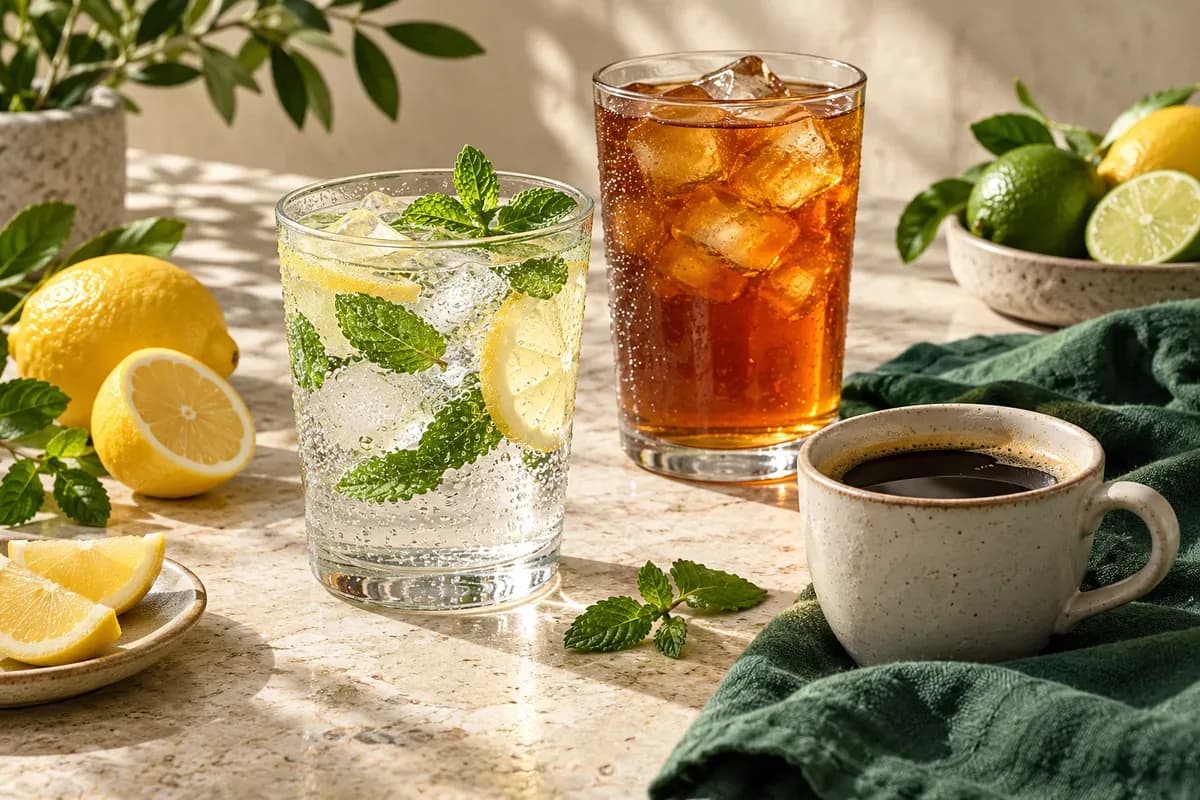
Keep a jug of chilled water where you can see it. Try cucumber slices, mint or a few berries if you enjoy the flavour, or choose plain sparkling water for the bubbles. These are serving ideas, not detox recipes. There is no special combination you need to buy, and plain tap water is an equally valid choice where it is safe to drink.
For iced tea, brew a tea you already enjoy, cool it and serve over ice without automatically adding syrup. If that tastes too unfamiliar, make a smaller change first. At work, bring a bottle or leave a glass near your desk if that makes the alternative easier to reach. Convenience is part of making a swap usable.
Where do juice and smoothies fit?
Whole fruit and fruit juice are not interchangeable. Juice can taste refreshing and still be a source of free sugars. Read the amount you pour as well as any no-added-sugar wording. Choosing water alongside a meal and enjoying whole fruit separately is one possible change; it is not a rule that you must never drink juice.
Smoothie recipes vary, so avoid assuming that the word alone tells you the drink’s nutritional value. Look at the ingredients, the portion and whether you are buying a drink or a substantial food-based meal. A large cup does not become automatically low in sugar because its contents started as fruit. If you need individual dietary guidance, ask a qualified professional.
What about zero-sugar soft drinks?
WHO’s 2023 non-sugar-sweetener guideline conditionally advises against using these sweeteners for long-term weight control or disease prevention. This is not a toxicological safety assessment of each sweetener. The recommendation excludes people with pre-existing diabetes, who need appropriate individual advice.
A zero-sugar drink and an unsweetened drink are different choices. If you use the former while changing a routine, be clear about your aim: replacing a sugary drink is not evidence that the new drink causes weight loss. You can also explore less-sweet drinks. The choice need not become a debate about whether someone has made a perfect purchase.
Try a small plan for the coming week
Choose one regular occasion and decide the replacement before it arrives. For example: at lunch, put a chilled bottle of water beside your usual food; at the café, request less syrup; in the evening, make an unsweetened tea you enjoy. Buy or prepare what you need in advance. Keep the plan narrow enough to work on a busy day.
After a few days, ask whether it was convenient, enjoyable and affordable. If not, change the option or the occasion. A social drink or a busy afternoon does not erase the choices you made earlier. Use what you learn to pick your next step instead of building a longer list of things you are no longer allowed to have.
For a broader view of sugar and everyday choices, read Sugar & Health. If you are considering honey, dates or sweeteners, our guide to sugar alternatives explains what those swaps actually change.
Continue with honey, dates and stevia compared for a practical look at sweetness, food preparation and claims.
Sources and editorial note
European Commission: Nutrition labelling
WHO: Use of non-sugar sweeteners, 2023 guideline
Prepared for GRZ’s public education pages with AI assistance. Sources checked on 18 October 2026. This article has not received clinical or medical review. Examples are illustrative, not product endorsements or individual dietary advice. If you manage diabetes or another condition affecting your diet, ask a qualified healthcare professional about changes appropriate for you.
Keep exploring
A little more food for thought.
Honey, Dates or Stevia: What Changes When You Swap Sugar?
Natural, sugar-free and less sweet mean different things. A balanced guide to choosing alternatives for drinks, breakfast and home baking.
Read article
How to Read Sugar on Food Labels: An EU Shopping Guide
Turn the packet around. A practical guide to total sugars, ingredient lists and no-added-sugar claims, with a simple EU label comparison.
Read article