

Sugar & Health
How to Read Sugar on Food Labels: An EU Shopping Guide
Turn the packet around. A practical guide to total sugars, ingredient lists and no-added-sugar claims, with a simple EU label comparison.
Reading sugar on food labels gets easier when you separate three questions: how much sugar is in the food, where it comes from, and how much you normally eat. This guide uses European Union labels, including those you will find in Germany. You do not need to memorise dozens of ingredient names or turn every shopping trip into a nutrition exam.
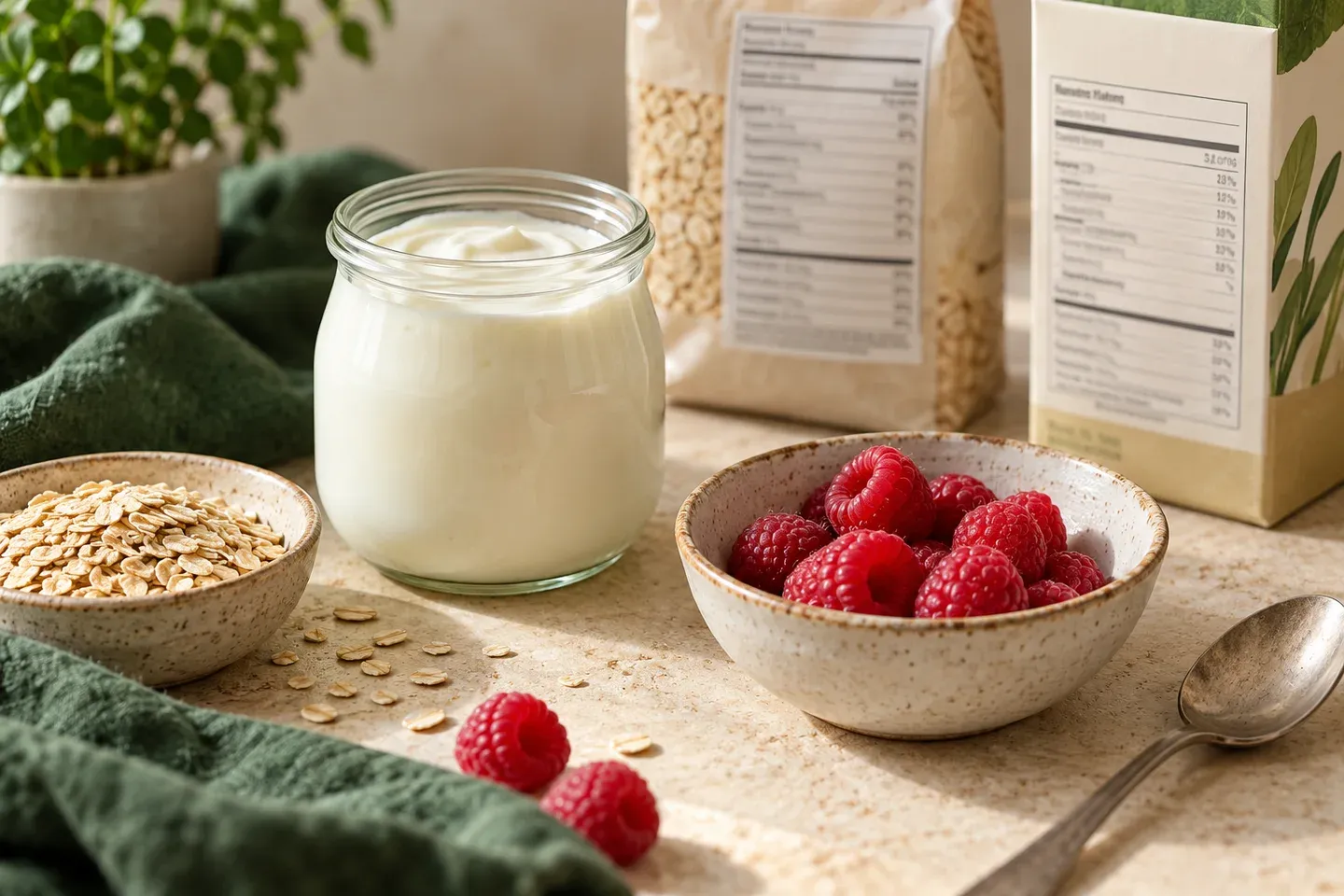
Start with something you buy regularly: yoghurt, cereal, a sauce or a drink. Put two comparable products side by side. Read the same part of each label before looking at the front-of-pack promises. One informed choice you can repeat is a more useful outcome than a trolley full of unfamiliar foods you will not enjoy.
1. Find the sugars line, then check the unit
The European Commission’s nutrition-labelling guidance explains that the standard declaration gives sugars per 100 g or 100 ml. A manufacturer may also show a portion. Use the 100 g/ml figures when comparing like with like; portion sizes on two packets may differ.
Read the line for sugars rather than treating all carbohydrate as sugar. Imagine two plain-looking breakfast cereals: cereal A shows 18 g sugars per 100 g, while cereal B shows 7 g. Those figures describe the same weight of food. They make a clearer comparison than a large serving on one packet against a small serving on the other.
These are fictional examples, not ratings of real brands. If your serving of cereal A weighs 40 g, its labelled sugars work out as 18 × 40 ÷ 100 = 7.2 g. The same serving of cereal B provides 2.8 g. This calculation describes total sugars in that serving; it does not reveal an exact added-sugar amount.
2. Total sugars and added sugars answer different questions
The sugars figure includes sugar naturally present in ingredients as well as sugar added during production. A plain dairy yoghurt can therefore show sugars without containing added table sugar. For the bigger picture, see our introduction to sugar and health.
The standard EU declaration does not give a separate mandatory added-sugars number. You cannot subtract the sweetness of a strawberry or the milk sugar in yoghurt just by looking at the total. Avoid writing down a precise added-sugar estimate when the packaging does not provide enough information. A useful comparison does not need that false precision.
3. Use the ingredients to understand the recipe
According to the Commission’s EU food-labelling overview, ingredients appear in descending order by weight. Look for familiar sweetening ingredients such as sugar, honey or glucose syrup. Position gives you context, but a list alone does not tell you how many grams each ingredient contributes.
Read the whole list rather than searching for one villainous word. A product can contain more than one sweetening ingredient, and a short list is not automatically a better food. Compare the product’s purpose, its nutrition declaration and whether you actually like it. You can prefer one cereal without declaring every other breakfast off limits.
4. Read no-added-sugar claims with the back label
EU conditions for nutrition claims distinguish sugar-free from no added sugars. The latter restricts added sugars and foods used for sweetening; naturally occurring sugars can remain. A sugar-free claim requires no more than 0.5 g sugars per 100 g or 100 ml.
A no-added-sugars juice can still contain sugars from fruit. The claim describes a condition of the product, not a promise that you can drink an unlimited amount. Equally, a food without a claim may fit your meals perfectly well. Use the wording as one piece of information, then return to the amount and ingredients.
5. Compare foods that do the same job
Comparing a yoghurt with a biscuit by sugar alone tells you little about which one suits breakfast. Compare two yoghurts, two drinks or two cereals first. Then consider the broader meal: texture, portion, fibre, protein, cost and convenience may all matter. Reducing added sugar should still leave you with food that is practical and satisfying.
For yoghurt, you might compare a flavoured pot with plain yoghurt plus fruit. For cereal, you might mix your usual option with plain oats rather than replace it overnight. Both are experiments you can try at home. Neither requires you to pretend that every packet with a higher number is a bad purchase.
A one-minute shopping check
First, choose two products with the same use. Second, find sugars per 100 g or 100 ml on each. Third, check the ingredients for the source of sweetness. Fourth, consider the amount you normally eat. Finally, decide whether the lower-sugar option is enjoyable, affordable and convenient enough to buy again. Photograph the labels if you prefer to compare them later.
You can practise with one category this week and leave the rest of your shopping alone. If the first alternative disappoints, try another texture or flavour instead of treating the whole effort as a failure. Keep the comparison simple enough to use when you are tired, hurried or shopping in an unfamiliar supermarket.
Drinks are another good place to practise the same comparison. Our guide to reducing sugar in drinks walks through café orders, bottled drinks and options to keep at home.
If you prefer to make something yourself, explore GRZ’s recipes. A homemade recipe can make ingredients easier to see, although homemade does not automatically mean lower sugar. Judge the recipe and portion rather than the label alone.
Sources and editorial note
European Commission: Nutrition labelling
European Commission: Food labelling in the EU
European Commission: Conditions for nutrition claims
Prepared for GRZ’s public education pages with AI assistance. Sources checked on 18 October 2026. This article has not received clinical or medical review. Examples are illustrative, not product endorsements or individual dietary advice. If you manage diabetes or another condition affecting your diet, ask a qualified healthcare professional about changes appropriate for you.
Keep exploring
A little more food for thought.
Honey, Dates or Stevia: What Changes When You Swap Sugar?
Natural, sugar-free and less sweet mean different things. A balanced guide to choosing alternatives for drinks, breakfast and home baking.
Read article
How to Reduce Sugar in Drinks Without Giving Up Flavour
Keep the coffee break, change the default. Simple drink swaps, a useful label calculation and a flexible plan for your everyday routine.
Read article